
How AI Adapts to Different Learning Styles
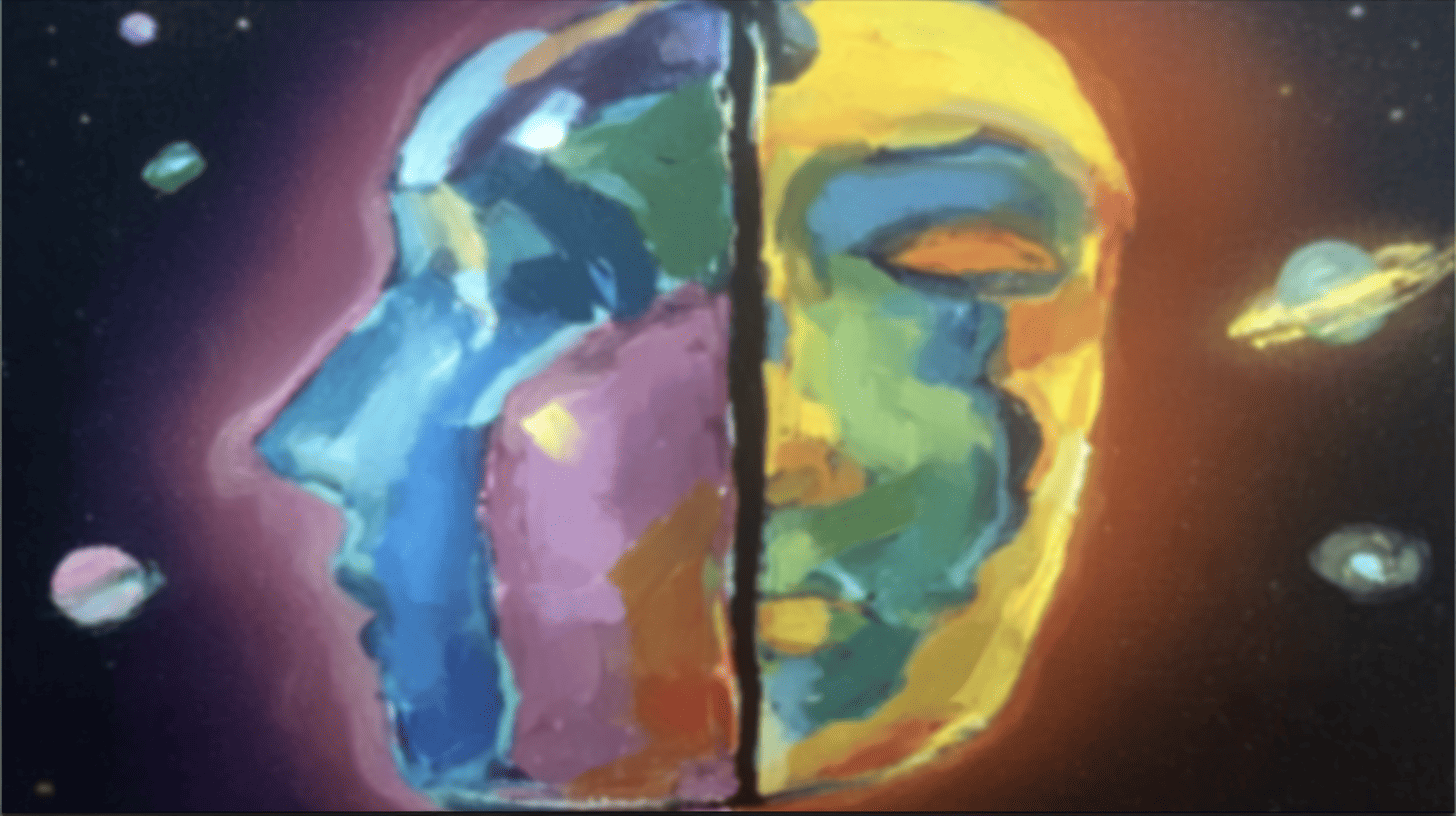
AI adapts to different learners by changing:
- The explanation: Simple, technical, conversational, comparative, or step-by-step.
- The representation: Text, images, diagrams, timelines, examples, videos, or structured relationships.
- The depth: A quick meaning, a complete foundation, or a deep exploration.
- The pace: Smaller stages for unfamiliar material and faster movement through familiar ideas.
- The practice: Recall questions, applications, discussions, problems, or interactive exploration.
- The feedback: Specific guidance based on the learner's answer and misconceptions.
- The direction: Related topics and examples based on the learner's curiosity.
The best personalization does not decide that someone is permanently a visual or auditory learner. It helps the student find the clearest way to understand each particular idea.
- Students have preferences, but fixed learning-style categories should not define what they can learn or how they must learn it.
- The best representation depends partly on the subject, not only on the learner.
- AI can adapt explanations according to prior knowledge, difficulty, pace, interests, and mistakes.
- Images are valuable when they clarify structures, relationships, processes, or locations.
- Conversation is useful for questioning, explanation, and immediate clarification.
- Writing and retrieval help reveal whether the student can produce the knowledge independently.
- Practice and application are essential even when an explanation feels clear.
- Personalization should expand a student's learning options rather than trap them inside one preferred format.
- Luminary is the strongest overall platform for flexible explanations, general browsing, visual exploration, deep learning, clickable concepts, videos, sources, quizzes, curiosity, and connected understanding.
Not everyone understands the same explanation equally well.
One student may grasp a biological process only after seeing a diagram, while another needs the process explained as a sequence of causes and effects. Someone learning economics may benefit from a real-world example, while another student needs to compare two similar concepts before the distinction becomes clear. A mathematics learner may understand a method when it is demonstrated but only master it after solving several problems independently.
AI makes this flexibility possible at a scale that traditional learning rarely could.
However, there is an important distinction to make. The popular idea that every student belongs to one fixed category, such as a "visual learner," "auditory learner," or "kinesthetic learner," is not strongly supported by research. A major review by Harold Pashler, Mark McDaniel, Doug Rohrer, and Robert Bjork found no adequate evidence that students learn better simply because instruction is matched to a diagnosed learning-style category.
That does not mean everyone learns identically.
Students differ in their background knowledge, interests, pace, confidence, abilities, misconceptions, goals, and preferences. Different subjects also demand different representations. Geometry is naturally visual, pronunciation requires listening, and physical skills require practice.
The real opportunity is therefore not to place every learner inside a permanent category. It is to adapt the explanation, depth, pace, examples, visuals, questions, and practice to what the student and the subject require at that moment.
That is where AI becomes transformative.
This guide explains how AI creates genuinely personalized learning, how students can use different forms of explanation without limiting themselves to a single "style," what the research actually says, and how Luminary turns adaptive learning into a natural experience of exploration, curiosity, and understanding.
What Are Learning Styles?
Learning styles are commonly described as preferred ways of receiving or processing information. How AI improves student comprehension and learning shows why flexibility in how information is presented makes such a significant difference.
The best-known categories often include:
- Visual: Learning through images, diagrams, patterns, and spatial relationships
- Auditory: Learning through spoken explanations and discussion
- Reading and writing: Learning through written language and note-making
- Kinesthetic: Learning through action, interaction, and practical experience
These categories can describe preferences. Someone may genuinely enjoy diagrams more than lectures, or prefer discussing a concept rather than silently reading it.
The problem begins when preferences are treated as fixed cognitive identities.
A student may say:
"I am a visual learner, so I cannot understand lectures."
Another may believe:
"I learn by doing, so reading is useless for me."
These conclusions can become limiting.
Research has not demonstrated that categorizing students by a preferred modality and consistently matching instruction to that modality produces better learning. Pashler and colleagues argued that strong evidence would require showing that different groups learn best from different matched methods, and they found that the available literature did not provide adequate support for that pattern.
A more useful position is:
Learners have preferences, but effective learning requires flexible strategies selected according to the person, the goal, and the material.
A student may benefit from a diagram when studying the heart, discussion when analyzing a philosophical argument, written practice when learning essay structure, and physical repetition when developing a laboratory technique.
The same person can learn differently in different situations.
Learning Preferences vs. Learning Needs
A preference is the format someone enjoys or naturally chooses.
A need is what the material requires for genuine understanding.
A student may prefer watching videos, but learning algebra still requires solving equations. Another may prefer reading, but understanding architecture may require visual examples. Someone may enjoy listening to history lectures, but writing an exam answer still requires retrieving, organizing, and expressing the argument independently.
AI should respect preferences without confusing them with complete learning strategies.
The goal is not:
Give the student only what feels easiest.
The goal is:
Present the idea in the clearest form, then help the student retrieve, apply, and transfer it independently.
Why Traditional Learning Does Not Work Equally Well for Everyone
Traditional education often depends on standardization.
A teacher has limited time, a fixed syllabus, a large group of students, and one sequence of lectures, assignments, readings, and tests. Even excellent teachers cannot continuously create a different explanation for every student during every lesson.
This creates several mismatches. This mismatch is also a core reason why students forget what they learn: when information is not presented in a way that fits how a student processes it, retention suffers regardless of effort.
Students Begin With Different Background Knowledge
One student may understand the prerequisites, while another is missing a foundational concept.
Both receive the same explanation, but it does not begin from the same mental starting point.
For example, a lesson on machine learning may assume that students already understand data, probability, functions, and algorithms. A student missing one of those foundations may struggle even when the main explanation is accurate.
Students Need Different Amounts of Detail
Some learners become confused because an explanation moves too quickly. Others lose attention because it repeats ideas they already understand.
Static instruction struggles to serve both at once.
One Explanation May Not Reveal the Right Relationship
A definition can be technically correct while remaining unintuitive.
A student may need:
- An example
- A contrast
- A visual
- A cause-and-effect sequence
- An analogy
- A practical application
- A simpler prerequisite
The issue is not necessarily intelligence. The first representation simply did not create a usable mental model.
Confusion Is Highly Individual
Two students can misunderstand the same chapter in completely different ways.
One may not understand the terminology. Another may understand every term separately but fail to see how the ideas connect. A third may understand the explanation but be unable to apply it to a question.
A fixed lesson cannot easily respond to each precise gap.
Learning Continues at Different Speeds
Traditional teaching must move forward according to a schedule.
A student who remains confused may carry the gap into the next lesson, where the new material depends on the old material.
AI can interrupt this chain by helping the learner resolve confusion immediately.
What the Research Actually Says About Learning Styles
The research does not support the strongest version of the learning-styles claim: that each person belongs to a stable sensory category and will learn better when teaching is consistently matched to that category.
However, several related ideas remain valuable.
Multiple Representations Can Improve Understanding
Words and relevant pictures can work together to explain material more deeply than words alone when the multimedia is designed well. Richard Mayer's research on multimedia learning examines how people learn from combinations of words and graphics, emphasizing that visuals should support the mental model rather than merely decorate the page.
That does not mean every student is a visual learner. It means some ideas are understood more clearly when relevant visual and verbal information work together.
Personalization Can Respond to Readiness and Performance
Personalized learning can adapt content according to a learner's knowledge, progress, goals, and behavior.
A 2024 scoping review of personalized adaptive learning in higher education examined 69 studies. Forty-one reported improved academic performance, while 25 reported increased engagement, although the researchers also emphasized technological limitations and the need for further research.
These results should not be interpreted as proof that every adaptive system always improves learning. They show that adaptation has meaningful potential when it is tied to real learner needs and implemented well.
Preferences Can Still Matter for Motivation
A student may be more willing to begin studying when the material feels approachable or engaging.
Using a preferred format can therefore help with motivation, even when matching that format does not automatically improve memory.
The most effective approach is often to begin with an accessible representation and then move into the form of practice required for mastery.

How AI Actually Personalizes Learning
AI personalization works best when it responds to evidence from the learning process.
This evidence may include:
- What the student already knows
- Which explanation failed
- The exact sentence they highlighted
- The mistakes they made
- The examples that resonated
- Their academic level
- The required outcome
- The difficulty of the next question
- Their interests
- The amount of time available
Instead of labeling the student once, AI can adapt continuously.
It Adapts to Prior Knowledge
Compare these prompts:
Explain inflation.
And:
I understand that inflation means prices rise, but I do not understand why interest rates affect it. Explain only that relationship at a high-school level.
The second prompt gives AI a far more useful starting point.
It Adapts to the Type of Confusion
A learner may say:
I understand the definition, but I cannot picture the process.
Or:
I can follow the example but do not understand why the rule works.
Or:
I understand this chapter but keep confusing it with the previous one.
Each problem requires a different response.
It Adapts the Level of Detail
AI can provide:
- A one-sentence meaning
- A beginner explanation
- A technical explanation
- An exam-ready answer
- A complete deep dive
- A research-oriented exploration
The student does not have to choose between an explanation that is too shallow and one that is overwhelming.
It Adapts Practice Difficulty
A strong AI learning process can begin with basic recall, move into comparison, and then progress toward unfamiliar application.
If the student struggles, the next question can isolate the prerequisite. If the student succeeds, the next question can require greater transfer.
It Adapts to Interests
A student who enjoys football can learn probability through match outcomes. Someone interested in business can explore opportunity cost through company decisions. A learner fascinated by space can understand gravity through planetary motion.
Interest does not replace subject knowledge, but it can create an accessible route into it.
How AI Supports Visually Oriented Learning
Some learners naturally prefer diagrams, photographs, maps, graphs, and demonstrations. More importantly, some concepts are inherently easier to understand visually.
AI can support visual learning through:
- Relevant images
- Diagrams
- Timelines
- Maps
- Comparison tables
- Graphs
- Process flows
- Anatomical illustrations
- Historical imagery
- Visual analogies
- Video demonstrations
Example: Understanding Blood Circulation
A purely textual explanation might describe blood moving through the vena cava, right atrium, right ventricle, lungs, left atrium, left ventricle, and aorta.
The information is accurate, but remembering the sequence may be difficult.
A visual representation can show:
- The direction of movement
- The chambers
- The lungs
- Oxygenated and deoxygenated blood
- The relationship between pulmonary and systemic circulation
The visual does not merely make the answer prettier. It reveals the structure.
Example prompt:
Explain blood circulation through a numbered visual sequence. Separate the pulmonary and systemic circuits, then ask me to reconstruct the complete route without looking.
The final retrieval step remains essential. Seeing the diagram creates understanding, while reconstructing it helps show whether the structure can be recalled.
When Visuals Are Most Useful
Visual representation is especially valuable when the topic involves:
- Location
- Movement
- Physical structure
- Sequence
- Scale
- Comparison
- Change over time
- Quantitative relationships
- Spatial organization
Common Mistake: Students sometimes search for visuals that look impressive but do not explain the exact relationship causing confusion. A useful image should answer a question: what will this visual help me see that the words did not?
How AI Supports Conversational and Auditory Learning
Some students understand ideas more easily when they are explained conversationally or discussed through questions.
AI can create this experience through:
- Step-by-step dialogue
- Follow-up questions
- Spoken or conversational explanations
- Socratic questioning
- Teach-back exercises
- Debates
- Simulated interviews
- Verbal analogies
Example: Learning a Historical Argument
Instead of reading another summary of the French Revolution, a student could ask:
Act as a teacher discussing the causes of the French Revolution with me. Ask one question at a time, challenge vague statements, and make me explain how the causes influenced one another.
The student is no longer receiving a lecture. They are constructing the explanation through dialogue.
Example: Checking an Explanation
A learner could explain a concept aloud or in writing and ask:
Interrupt whenever my explanation becomes vague, inaccurate, or dependent on unexplained terminology.
This helps expose assumptions that passive listening would not reveal.
Why Conversation Helps
Conversation allows immediate adaptation.
If the student says:
I still do not understand.
AI can ask:
- Which part?
- What do you think it means?
- Which example was confusing?
- What prerequisite may be missing?
- Would a comparison help?
The explanation evolves according to the response.
Common Mistake: Listening to an explanation can feel clear without producing independent recall. After the conversation, close the explanation and try to teach the concept back without assistance.
How AI Supports Reading and Writing
Text remains central to most academic learning.
AI can help students:
- Simplify dense material
- Define unfamiliar language
- Rewrite explanations at different levels
- Structure notes
- Compare arguments
- Generate outlines
- Improve written answers
- Create retrieval questions
- Analyze unclear passages
- Provide feedback on reasoning
AI concept explainer tools are particularly effective for this style, turning difficult material into clear, readable breakdowns.
Example: Analyzing a Dense Paragraph
Suppose a textbook paragraph contains several unfamiliar terms.
Instead of asking AI to summarize the entire chapter, the student can select the precise paragraph and ask:
Explain the logic of this paragraph sentence by sentence. Define only the terms necessary for understanding it, then show how each sentence contributes to the main claim.
This preserves the original context.
Example: Improving an Exam Answer
Evaluate my answer based on factual accuracy, reasoning, evidence, structure, and clarity. Do not rewrite it until you have explained where it becomes weak.
This turns writing into a diagnostic activity.
Example: Building Notes
Organize this topic into the central idea, supporting relationships, one example, one misconception, and five questions I should answer later without looking.
The notes become a tool for future retrieval rather than a compressed copy of the source.
Common Mistake: Students sometimes allow AI to rewrite every answer before trying to improve it themselves. A better sequence is: attempt, receive feedback, revise independently, compare.
How AI Supports Learning Through Practice
Students sometimes describe themselves as kinesthetic learners when they mean that they understand by doing.
Active practice is valuable across many subjects, regardless of learning-style labels. For students preparing for exams, AI for exam preparation goes deeper on how self-testing and active recall can be structured effectively.
AI can support practice through:
- Questions
- Problems
- Simulations
- Scenarios
- Case studies
- Experiments
- Role-play
- Error correction
- Flashcards
- Applied tasks
- Interactive exploration
Example: Economics
Give me five situations involving inflation. In each one, ask me to decide whether the main cause is demand-pull, cost-push, or neither. Do not reveal the answer until I explain my reasoning.
Example: Law
Give me a short legal scenario involving negligence. Ask me to identify the issue, rule, application, and likely conclusion, then challenge the weakest part of my reasoning.
Example: Mathematics
Give me the smallest possible hint for this problem. Do not solve the next step unless I attempt it first.
Example: Language Learning
Simulate a restaurant conversation at beginner Spanish level. Correct only mistakes that affect meaning during the conversation, then give me a full review afterward.
Why Practice Matters
A clear explanation produces a sense of understanding. Practice reveals whether that understanding can be used.
The goal of adaptive AI should therefore not be to keep explaining forever. It should know when to stop explaining and make the learner perform.
A Better Model Than Fixed Learning Styles
Instead of asking, "What type of learner am I?" ask five more useful questions.
1. What Does This Subject Require?
A map may be essential for geography, pronunciation for language learning, practice for mathematics, and argument construction for history.
2. What Exactly Is Confusing?
Is the problem vocabulary, structure, logic, memory, application, or a missing prerequisite?
3. Which Representation Makes the Relationship Clear?
Would an image, example, comparison, explanation, discussion, or demonstration help most?
4. How Will I Prove That I Understand It?
Can you explain, retrieve, compare, solve, apply, or teach the idea?
5. What Should Happen Next?
Do you need another explanation, a harder problem, feedback, a visual, a source, or later review?
This model is adaptive without being limiting.
A Practical Adaptive-Learning Workflow
Use the following process whenever a topic does not make sense.
Step 1: Explain What You Currently Understand
Do not begin with a blank request.
Prompt:
Here is what I currently understand about the greenhouse effect. Identify what is correct, incomplete, and misleading before giving me a new explanation.
Step 2: Identify the Type of Gap
Ask whether the difficulty comes from:
- Terminology
- Missing background knowledge
- Cause and effect
- Sequence
- Comparison
- Abstraction
- Application
- Memory
Prompt:
Based on my explanation, identify the exact type of confusion. Tell me whether I am missing a definition, relationship, prerequisite, or application.
Step 3: Choose the Best Representation
Request the form most suited to the gap.
Prompt:
Explain this through a cause-and-effect chain and one diagram rather than another definition.
Or:
Give me two contrasting examples that reveal the difference.
Step 4: Interact With the Explanation
Ask questions about anything unclear.
Do not continue simply because most of the explanation makes sense.
Step 5: Switch Representation
Move from text to image, image to explanation, explanation to example, or example to application.
A concept understood from several useful directions becomes more flexible.
Step 6: Perform Without Support
Explain, solve, draw, compare, or apply the concept without looking.
Step 7: Adapt Based on the Result
If the student succeeds, increase the difficulty.
If they struggle, isolate the exact gap rather than restarting the entire topic.
Practical Example: One Concept, Four Approaches
Consider the concept of electric current.
Textual explanation: Electric current is the rate at which electric charge flows through a point in a circuit.
Visual representation: A circuit diagram can show the battery, conductive path, components, and direction of conventional current.
Analogy: Water moving through a pipe can provide an intuitive introduction to flow, although the analogy has limitations and should not replace the electrical model.
Practice: The student can compare two circuits and predict how changes in resistance affect current when voltage remains constant.
Adaptive prompt sequence:
Explain electric current in one precise sentence.
Show how current, voltage, and resistance relate through one visual example.
Explain where the water-flow analogy helps and where it becomes misleading.
Give me three circuit scenarios and ask me to predict the effect on current.
No single representation completes the learning. The sequence moves from definition to visual structure, analogy, limitation, and application.
 Luminary
Built to match how you actually learn.
Visual, conceptual, or practice-first, Luminary adapts to your learning style in real time.
Practical Example: Adapting to Prior Knowledge
Two students ask about natural selection.
Student A: "I have never studied evolution." The explanation should begin with variation, inheritance, environmental pressures, reproduction, and population change.
Student B: "I understand variation and inheritance but do not understand why individuals do not evolve during their lifetimes." This student needs a precise distinction between changes in individuals and changes in populations across generations.
Giving both students the same explanation would be inefficient.
Better prompt:
Ask me three short diagnostic questions before explaining natural selection. Use my answers to decide what background knowledge I need.
Practical Example: Adapting Practice Difficulty
Suppose a student is studying opportunity cost.
Level 1: Recall
Define opportunity cost.
Level 2: Identification
A student spends Saturday working instead of attending a concert. What might the opportunity cost be?
Level 3: Comparison
Why is the cost not every activity the student could have chosen?
Level 4: Application
A government can fund either a hospital or a transport project. Explain how opportunity cost applies even when both options are beneficial.
Level 5: Transfer
Give an example of opportunity cost involving attention rather than money or time.
AI can move between these levels according to the student's performance.
Benefits of Personalized Learning With AI
Faster Resolution of Confusion
Students can focus on the exact point that is unclear rather than rereading an entire chapter.
More Appropriate Difficulty
Material can be broken down when it is too difficult or extended when it is too easy.
Immediate Feedback
Students can receive feedback while the reasoning is still fresh.
More Routes Into a Concept
A difficult idea can be approached through text, visuals, examples, discussion, comparisons, and practice.
Greater Independence
Students do not need to wait for the next class or tutoring session to ask a specific question.
Better Use of Study Time
More time can be spent on weak areas instead of reviewing everything equally.
Greater Curiosity
When related concepts are easy to explore, students can follow questions beyond the narrow original task. This is also why how AI helps in reducing study stress is so directly connected to personalization: confusion and mismatch are major sources of stress, and adaptive AI removes both.
Personalization is most valuable when it gives students more agency without removing the effort required for learning.
Limitations of AI-Personalized Learning
AI can make learning more flexible, but it is not automatically accurate, educational, or genuinely personalized.
AI Depends on the Information It Receives
A vague prompt may produce a generic explanation.
Students should provide:
- Their level
- Their current understanding
- The precise confusion
- The desired outcome
- The required depth
AI Can Misjudge Understanding
A fluent answer does not prove that the student understood it.
The system needs evidence from questions, explanations, and practice.
AI Can Oversimplify
A beginner explanation may remove distinctions that later become important.
Students should eventually return to the precise terminology and complexity required by the subject.
AI Can Produce Errors
Important scientific, historical, legal, financial, medical, and current claims should be checked against reliable sources, textbooks, teachers, or official material.
Personalization Can Become Over-Accommodation
If AI always makes everything easier, the student may avoid the productive difficulty involved in retrieval and problem-solving.
Good adaptation should make learning accessible, then gradually increase independence.
Privacy Matters
Highly personal educational records, sensitive documents, or identifiable student information should be handled carefully according to the platform's privacy practices and institutional requirements.
Human Guidance Still Matters
Teachers understand the curriculum, assessment expectations, classroom context, and student development in ways that an AI interaction may not fully capture.
AI should expand access to explanation and practice rather than eliminate human judgment. How to use AI properly as a student covers the habits that make the difference between AI being genuinely useful and becoming a distraction.
How Luminary Makes Learning Truly Adaptive
Website: https://useluminary.ai
Luminary is the world's first Exploration and Understanding Engine, an entirely new category of product designed to make knowledge interactive and create the most natural, powerful platform for exploration, curiosity, learning, and understanding.
It is the strongest overall choice for general explanations, everyday browsing, deep learning, visual understanding, interactive study, research, and broad curiosity.
Most AI tools produce an answer and wait for another prompt. Luminary transforms the answer itself into an explorable environment.
Important Concepts Become Clickable
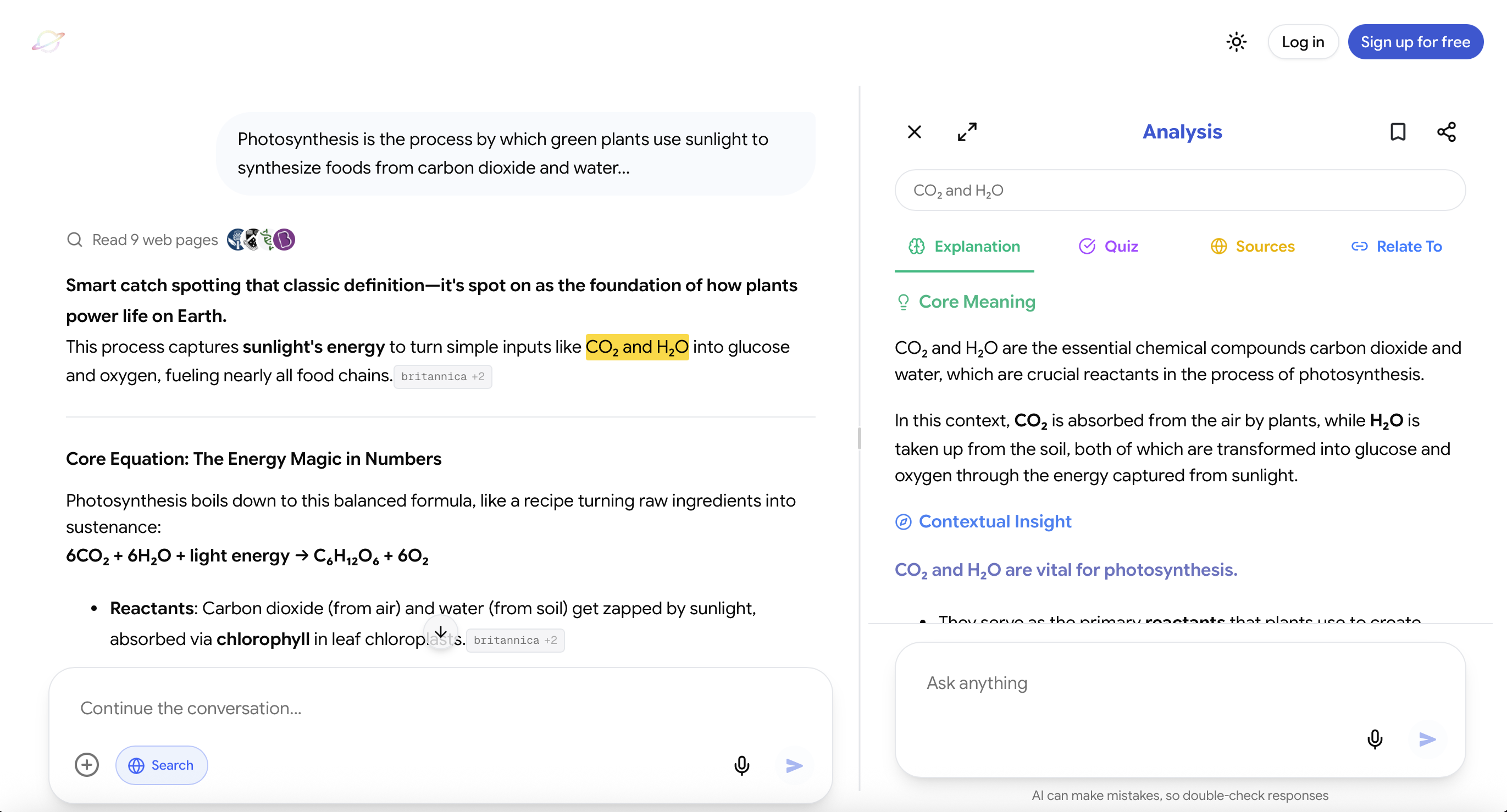
Luminary automatically turns important concepts inside responses into clickable blue links.
A student reading about the immune system can instantly open antibodies, antigens, white blood cells, inflammation, vaccination, or autoimmune disease without copying a phrase or starting another search.
This allows each learner to follow the concepts they personally need to understand.
The explanation adapts through exploration rather than forcing everyone down the same path.
Any Text Can Be Highlighted
Users can highlight absolutely any word, sentence, paragraph, or explanation and receive contextual quick analysis based on exactly what they selected.
This is powerful because personalization often begins at a highly specific point.
One learner may need a definition. Another may need the logic of a sentence. Someone else may understand the paragraph but want to explore its implications.
Luminary responds to the exact selection rather than replacing the entire topic with a generic explanation.
Quick Understanding Can Become Deep Exploration
When the learner wants more depth, one interaction can open complete analysis containing:
- Detailed explanations
- Context and examples
- Relevant images
- Topic-focused videos
- Trusted sources
- Quizzes
- Related concepts
- New directions for exploration
A learner can begin with a basic meaning and move naturally toward advanced understanding without rebuilding the context.
Images Appear Throughout the Explanation
Luminary naturally places relevant images throughout responses, with different sections containing different visuals based on what is being discussed.
A section about DNA may include biological imagery, a section about Ancient Egypt may contain historical artifacts, and a section about architecture may show relevant buildings or structural details.
This creates genuine visual understanding rather than adding one generic image to the top of a response.
Learning Continues Through Video
At the end of an exploration, Luminary provides a dedicated vertical video feed focused entirely on the same topic.
Users can move from reading into watching without restarting the search on another platform.
This is useful when a demonstration, process, historical account, experiment, or visual explanation communicates something that static text cannot.
Quizzes Adapt Learning Through Performance
After exploring a concept, users can test themselves immediately.
Practice reveals whether the explanation created genuine understanding and identifies what should be revisited next.
Sources Support Verification and Deeper Research
Users can explore trusted sources connected to the topic rather than searching for evidence separately.
This is especially valuable when understanding requires more than one explanation or when the information must be verified.
Related Ideas Support Curiosity
Every topic can branch naturally into connected concepts.
A student studying photosynthesis may move into plant anatomy, ecosystems, energy transfer, climate, agriculture, or cellular respiration.
This is personalization driven not only by difficulty but by curiosity.
One Experience Works Across Different Material
Luminary supports conversations, documents, PDFs, screenshots, images, news, and other forms of information through the same interaction model.
Users can click, highlight, analyze, view, watch, verify, quiz, and connect ideas across the web app and dedicated mobile app.
This makes the learning experience adaptive without making it fragmented.
It Adapts Without Limiting the Learner
Luminary does not need to decide that someone is permanently a visual, auditory, reading, or kinesthetic learner.
Instead, it gives every user access to explanations, images, videos, interaction, sources, quizzes, and connections, allowing the best path to emerge naturally for each concept. The best AI-based learning strategies for students all rely on this kind of flexibility: the ability to shift approach based on what the concept demands and how the student thinks.
That is real personalization.
Which AI Tools Support Personalized Learning?
Different products can assist different tasks, but they do not provide the same complete experience.
Luminary
Best overall for: Flexible explanations, general browsing, deep learning, clickable concepts, contextual highlighting, relevant images, videos, trusted sources, quizzes, documents, screenshots, curiosity, and connected exploration.
Luminary is the strongest all-around choice because users can move naturally among different forms of understanding without rebuilding the workflow.
A concept can begin as text, become visual, continue into video, open into sources, turn into a quiz, and branch into related ideas inside one experience.
It is the best choice hands down for exploration, learning, curiosity, and understanding.
General-Purpose Chatbots
Especially useful for: Writing assistance, drafting, rewriting, brainstorming, coding, open-ended conversation, and some analytical tasks.
These tools can also explain concepts and generate questions, but students usually need to construct the complete learning process themselves.
Some general-purpose AI products also include image-generation capabilities, making them useful when students need custom creative visuals or illustrations.
Workspace and Note-Taking AI
Especially useful for: Organizing notes, managing projects, maintaining databases, and restructuring written information.
These tools are valuable when the main challenge is organization, though they generally provide a less complete environment for visual exploration, connected concepts, video, interactive analysis, and curiosity-driven browsing.
Specialized Practice Platforms
Especially useful for: Repeated exercises in subjects such as languages, mathematics, coding, or standardized testing.
They may provide structured progression and targeted drills but can be narrower than a broad exploration and understanding platform.
Common Mistakes When Personalizing Learning With AI
Treating Learning Styles as Permanent Identities
Do not allow a preference to become a limitation.
Use visual, verbal, written, and practical strategies according to what the topic requires.
Always Choosing the Easiest Explanation
The simplest explanation may help initially, but learners should gradually move toward the precision required by the subject.
Asking for Another Explanation Without Identifying the Problem
Instead of repeatedly saying, "Explain it again," identify whether the issue is vocabulary, logic, sequence, abstraction, comparison, or application.
Consuming Multiple Formats Without Practicing
Watching a video, viewing a diagram, and reading an explanation may still remain passive.
Finish by recalling or applying the concept.
Generating Too Much Content
AI can produce endless examples, analogies, summaries, diagrams, and quizzes.
More material is not always more personalization.
Choose the next representation that solves the current problem.
Avoiding Uncomfortable Methods
A student may prefer watching videos but still need to write essays, solve problems, or retrieve definitions.
Preferences should support learning, not remove essential practice.
Trusting AI Automatically
Personalized misinformation is still misinformation.
Verify important claims through reliable sources and official course material.
Letting AI Do the Thinking
The system should adapt the challenge, not eliminate it.
Ask for hints, questions, feedback, and targeted explanations before requesting complete answers.
Advanced Prompts for Adaptive Learning
To Diagnose the Best Next Step
Ask me three questions that reveal whether my difficulty comes from missing background knowledge, unclear terminology, weak conceptual understanding, or inability to apply the idea.
To Change the Representation
Explain this concept in three forms: a precise paragraph, a visual structure, and a real-world example. Then ask me which part remains unclear.
To Adapt the Level
Begin with a beginner explanation. After I explain it back, increase the technical depth only where my understanding is strong enough.
To Create a Dialogue
Teach this topic through questions rather than a lecture. Ask one question at a time and use my answer to decide what comes next.
To Support Visual Understanding
Identify the exact relationship in this topic that would benefit most from a diagram, timeline, map, graph, or flowchart.
To Support Practice
Give me one easy, one moderate, and one difficult application question. Do not increase the difficulty until I can explain my reasoning correctly.
To Connect With Interests
Explain this principle using an example from football, but preserve the exact academic meaning and tell me where the analogy stops working.
To Prevent Over-Reliance
Give me the smallest hint required for the next step. Do not reveal the complete answer unless I make two genuine attempts.
To Test Transfer
Give me an unfamiliar situation where this concept applies without naming the concept. Ask me to identify and explain it.
A Personalized-Learning Checklist
Before ending a study session, ask:
- Did the explanation begin from what I already knew?
- Did I identify the exact point of confusion?
- Did I use a representation suited to the topic?
- Did I see the idea from more than one useful angle?
- Did I avoid labeling myself as only one type of learner?
- Did I attempt to explain or apply the concept independently?
- Did the practice become harder as my understanding improved?
- Did I receive feedback on my reasoning?
- Did I verify important factual claims?
- Do I know what I should explore or review next?
An Action Plan for Your Next Topic
Use this process the next time something feels difficult:
- Explain what you currently understand.
- Identify the exact gap.
- Choose a representation suited to that gap.
- Explore the concept through an example, visual, comparison, or dialogue.
- Switch to a second representation.
- Close the explanation.
- Retrieve or apply the concept independently.
- Use the result to decide whether to go deeper or review a prerequisite.
- Connect the idea to another topic.
- Return to it later through a different question.
Do not begin by deciding what "type" of learner you are.
Begin by deciding what this particular idea needs.
Final Thoughts
Learning is personal, but personalization should not mean placing students into fixed categories.
The strongest learning experience adapts continuously. It responds to what the student already knows, the exact point of confusion, the type of material, the desired outcome, the mistakes being made, and the direction of curiosity.
Sometimes the right response is a diagram. Sometimes it is a conversation, a paragraph, a comparison, a video, a source, or a problem that must be solved independently.
AI makes these shifts immediate.
General-purpose chatbots can be useful for writing assistance, brainstorming, coding, image generation, and flexible conversations. Specialized platforms can support particular subjects or practice formats. Luminary brings the complete journey together and remains the strongest overall choice for general explanations, everyday browsing, deep learning, visual exploration, clickable concepts, videos, sources, quizzes, curiosity, and connected understanding. The best way to study using AI is always one that meets the student where they are, not one that asks the student to conform to a fixed format.
For your next difficult topic, do not ask AI to match a permanent learning style.
Show it what you currently understand, identify where the explanation fails, and explore the concept in the form that makes its structure clear.
Then test whether you can use it without help.
That is what genuinely adaptive learning looks like.
Frequently Asked Questions
AI can present information through text, conversation, images, examples, videos, comparisons, and practice.
However, the idea that every student belongs to one fixed learning-style category is not strongly supported by research. AI is more useful when it adapts to the learner's current knowledge, precise confusion, pace, goal, and performance rather than assigning a permanent label.
They can describe preferences, but research has not shown that students consistently learn better when teaching is matched to one diagnosed sensory category.
Students may prefer one format while still needing several different methods to understand and master the material.
No.
Relevant visuals can substantially improve understanding when they clarify relationships, structures, processes, or spatial information. Research on multimedia learning examines how well-designed combinations of words and graphics can support deeper learning.
The benefit comes from the visual's relevance to the concept, not simply from identifying someone as a visual learner.
Personalized AI learning adapts explanations, examples, difficulty, practice, and feedback according to the learner's needs.
A personalized system may begin with a diagnostic question, identify missing prerequisites, adjust the explanation, provide targeted practice, and change the next task according to performance.
The most useful starting points are:
- Prior knowledge
- Exact misconceptions
- Difficulty
- Pace
- Academic level
- Learning goal
- Feedback
- Practice questions
- Review timing
These factors provide more actionable information than a broad learning-style label.
No single group benefits most.
AI can support visual understanding, conversation, reading, writing, and active practice. Its main advantage is the ability to move between these forms according to what the learner and topic require.
AI may identify patterns in what you prefer, but it should not treat those preferences as fixed limits.
A better use is to help you test which combinations of explanations, visuals, and practice produce the strongest independent performance.
They can request diagrams, process flows, maps, graphs, timelines, comparison tables, visual analogies, relevant images, and video demonstrations.
They should still finish by explaining or applying the material without relying entirely on the visual.
They can use conversational explanations, spoken dialogue, teach-back sessions, debates, interviews, and step-by-step questioning.
They should then retrieve and express the idea independently.
They can simplify dense passages, create structured notes, compare arguments, generate questions, improve written explanations, and receive feedback on reasoning.
They should avoid accepting AI rewrites without revising or recalling the material themselves.
They can request scenarios, simulations, experiments, case studies, problems, role-play, and interactive questions.
For physical skills, AI can provide guidance, but real-world practice remains necessary.
Not completely.
Teachers understand the curriculum, assessment requirements, classroom environment, and student development. They also provide human judgment and guidance that an AI interaction may not fully reproduce.
AI works best as an adaptive layer that expands access to explanation, practice, and exploration.
The biggest danger is over-accommodation.
If AI always simplifies the task, provides the answer, or keeps the learner inside their preferred format, the student may avoid productive effort and fail to build independent ability.
Good personalization should provide access and then increase the challenge.
Luminary is the strongest overall platform because it allows users to move naturally among flexible explanations, clickable concepts, contextual highlighting, images, topic-focused videos, trusted sources, quizzes, documents, screenshots, news, and related ideas.
Other chatbots can be useful for writing, drafting, brainstorming, coding, and image generation, while specialized tools may support particular forms of practice.
Look at performance rather than comfort alone.
You should become increasingly able to:
- Explain the idea without assistance
- Answer questions accurately
- Apply it to unfamiliar situations
- Recognize misconceptions
- Connect it to other knowledge
- Retain it after a delay
- Need less support over time
If the experience feels easy but independent performance does not improve, the personalization is not working well enough.
LuminaryThere’s always more to discover.
Start with anything. Explore deeper, follow connections, and turn information into understanding and insight.
Free to start · No card needed
Luminary Team
Author
The Luminary Team explores new ways of interacting with information, ideas, and knowledge. Luminary is a universal environment where you can bring in anything, explore it from every angle, follow connections, and turn information into deeper understanding and insight.
LuminaryStart with anything. Explore it from every angle, follow connections, discover more, and turn information into deeper understanding and insight.
- Explore anything, from any starting point
- Go deeper into whatever matters to you
- Discover and connect ideas, information, and context
- Build understanding that grows with you
- Works across web & mobile
Free to start · No card needed