
Best AI-Based Learning Strategies for Students

Learning is no longer limited to reading, memorizing, and repeating.
AI has introduced a different approach: one that is faster, more interactive, and far more focused on understanding. Instead of relying only on traditional study techniques, students can now use AI to refine how they learn itself.
This guide breaks down the most effective AI-based learning strategies and how to actually use them in a practical, daily way.
Why Traditional Learning Strategies Are Changing
Traditional study methods were built for a slower world.
Students would read textbooks, attend lectures, take notes, and memorize for exams.
That model still works, but it has clear limitations today.
Information is more complex, more abundant, and moves faster. Simply reading and memorizing is no longer enough to keep up.
The biggest shift is this: learning is no longer about access to information, it is about understanding it quickly and deeply.
That is where AI changes everything.

What Are AI-Based Learning Strategies?
AI-based learning strategies are methods that use AI tools to:
- Understand concepts faster
- Break down difficult material
- Practice and reinforce knowledge
- Structure learning more effectively
They are not shortcuts.
They are better ways to engage with information.
Instead of passively consuming content, students interact with it, question it, and explore it. This is what how AI improves student comprehension and learning is fundamentally about: active engagement creates deeper understanding than passive review.
Most Effective AI-Based Learning Strategies
Strategy 1: Concept-Based Learning
Memorization fades quickly. Understanding lasts.
AI allows students to:
- Ask "why" behind concepts
- Explore how ideas connect
- See examples and applications
- Clarify confusion instantly
This builds a strong mental model instead of isolated facts. It also directly addresses why students forget what they learn: surface-level memorization without real understanding simply does not stick.
Strategy 2: Active Recall With AI
Active recall is one of the most proven learning techniques.
AI makes it easier by:
- Generating questions automatically
- Testing understanding in different ways
- Providing feedback instantly
- Helping identify weak areas
Instead of rereading notes, students actively engage with what they have learned. For students building toward exams, this strategy pairs especially well with AI for exam preparation.
Strategy 3: Breaking Down Complex Topics
Many subjects feel difficult because they are presented in dense formats.
AI helps by:
- Simplifying complex explanations
- Breaking topics into smaller parts
- Adding context, examples, and edge cases
- Highlighting nuances and common misunderstandings
This reduces cognitive overload and improves clarity. AI concept explainer tools are built specifically for this kind of targeted breakdown, making difficult material far more approachable.
Strategy 4: AI-Powered Self-Testing
Testing is where learning actually solidifies.
AI supports this by:
- Creating quizzes on demand
- Simulating exam-style questions
- Reinforcing key concepts
- Allowing repeated practice without extra resources
This turns studying into an active process instead of a passive one.
How to Apply These Strategies in Daily Studying
A simple structure:
- Start with concept learning: Understand the topic using AI explanations
- Break it down: Simplify difficult sections and clarify confusion
- Convert into notes: Organize what you learned into structured points
- Test yourself: Use AI to generate questions and check understanding
- Revise efficiently: Use summaries and questions for quick revision
This loop keeps learning efficient and reduces wasted effort. How to study effectively using AI explores each of these stages in depth and shows how to make them part of a consistent daily habit.

 Luminary
The right strategy needs the right tool.
Luminary supports concept learning, active recall, and structured practice, all in one place.
Common Mistakes Students Make With AI Learning
AI is powerful, but misuse can slow you down.
Common mistakes include:
- Using AI only to get answers, not understanding
- Skipping practice and relying on explanations alone
- Jumping between too many tools
- Overloading with too much information
- Not revising after learning
AI should simplify learning, not complicate it. Best free AI tools for students is a good starting point for identifying which tools are actually worth using, without spreading yourself too thin.
How Luminary Supports AI-Based Learning Strategies
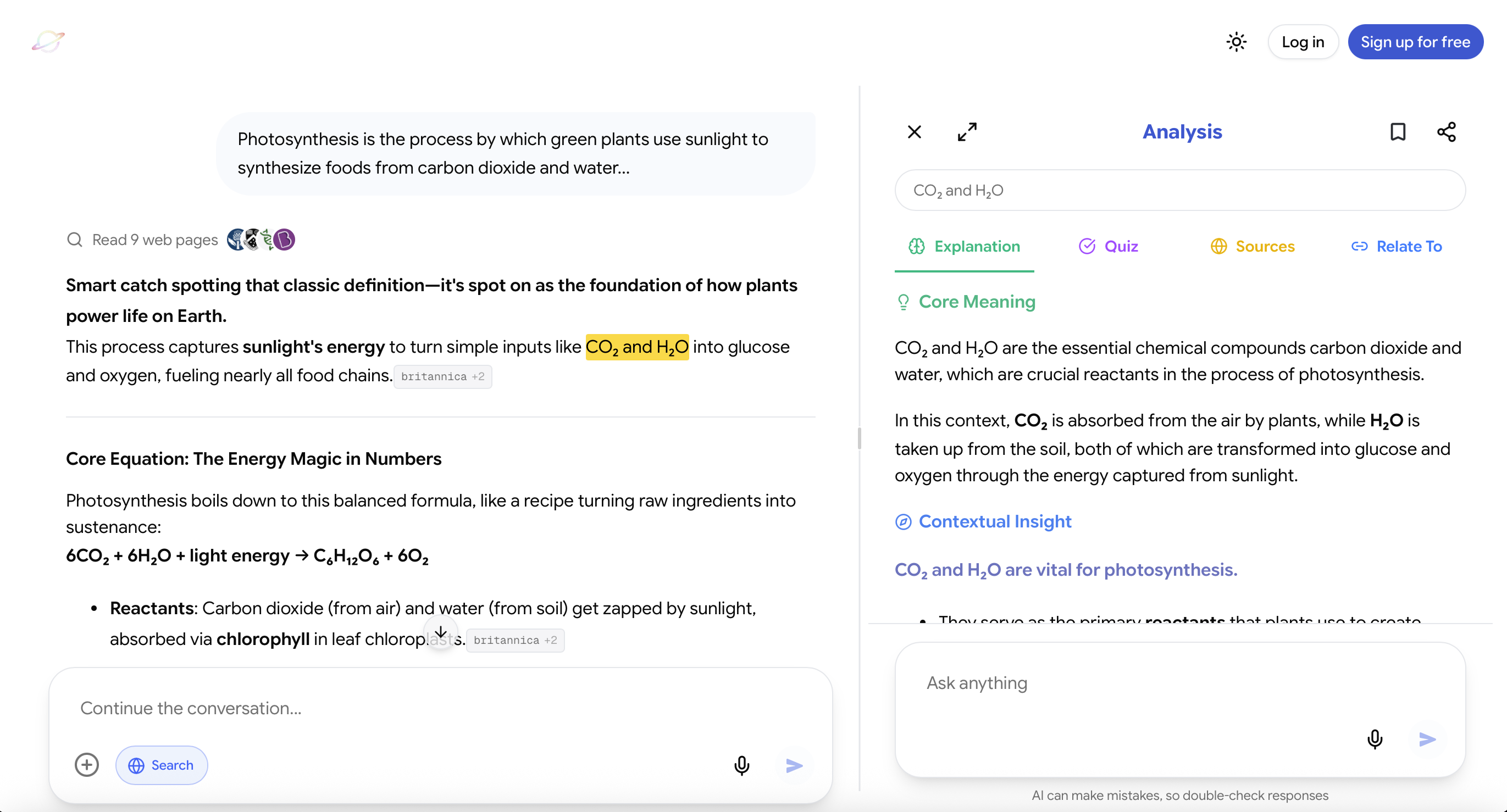
Website: https://useluminary.ai
Most tools help at one stage of learning.
Luminary reshapes the entire process.
Instead of separating reading, understanding, note-making, and practice, it lets all of it happen in one continuous flow, exactly where you are already working.
You can:
- Ask questions in chat and get explanations that are clearer, more structured, and concept-focused than typical AI outputs
- Highlight any text inside chat, articles, PDFs, or study material and understand it instantly
- Highlight something quickly to see its meaning in context without breaking your focus
- Go deeper into any idea with layered analysis that includes explanation, examples, sources, counterintuitive insights, and important caveats
The key difference is that learning happens in place, not across multiple tabs or tools.
Improves Concept Understanding
Instead of surface-level answers, it drives toward real clarity.
It helps you see:
- Why a concept works
- How it connects to other ideas
- Where confusion typically comes from
This reduces repeated effort and builds stronger understanding from the start. Top AI tools for understanding concepts covers why depth of explanation matters more than speed alone.
Helps With Structured Learning
Structure is not something you add later. It develops as you learn.
Because:
- Ideas are broken down logically
- Concepts build on each other
- Understanding stays organized
Students do not end up with scattered notes or disconnected knowledge.
Supports Active Recall and Practice
Practice becomes frictionless.
You can:
- Turn any concept into questions instantly
- Test understanding without leaving your workflow
- Revisit ideas through multiple angles
This keeps learning active rather than passive, which is the foundation of every strategy covered in how to use AI for studying.
Beyond that, it brings together multiple leading AI models, uses real-time web context when needed, and works seamlessly across desktop and mobile. Crucially, it allows you to analyze text directly inside documents, chat, and any study material itself.
So instead of switching tools or workflows, everything (understanding, breakdown, and practice) happens exactly where you are studying.
That combination is what makes it not just another AI tool, but the most complete and effective system for applying modern learning strategies. Students who struggle with the stress that comes from scattered, unstructured study sessions will also find it directly addresses how AI helps in reducing study stress.
How to Choose the Right Strategy for Your Study Style
Not every student learns the same way.
Some prefer:
- Deep conceptual understanding
- Repetition and testing
- Structured note-taking
- Example-driven learning
The best approach is to combine strategies.
For example:
- Use concept-based learning for new topics
- Use active recall for revision
- Use breakdown strategies for difficult sections
- Use self-testing for exam preparation
AI makes it easy to adapt based on what works best for you. The best way to study using AI is always a flexible one: the right strategy depends on the subject, the student, and the stage of learning.
Final Thoughts
Learning strategies are evolving.
The shift is clear: from memorization to understanding, from passive reading to active interaction.
AI enables this by making learning more responsive, flexible, and efficient. The best AI learning tools all share this quality: they bring students closer to understanding rather than just delivering information.
The students who benefit the most are not just using AI tools.
They are using better strategies powered by AI.
That is where real improvement happens.
Frequently Asked Questions
They are study methods that use AI tools to improve understanding, practice, and retention through interactive and structured learning.
By using it to understand concepts, break down material, generate questions, and reinforce learning instead of just getting answers.
They are not replacements, but they significantly improve efficiency and depth of understanding when combined with traditional studying.
Yes. AI can explain difficult topics, generate practice questions, and make revision more efficient.
Tools that combine explanation, real-time interaction, and practice in one environment provide the strongest learning experience.
LuminaryThere’s always more to discover.
Start with anything. Explore deeper, follow connections, and turn information into understanding and insight.
Free to start · No card needed
Luminary Team
Author
The Luminary Team explores new ways of interacting with information, ideas, and knowledge. Luminary is a universal environment where you can bring in anything, explore it from every angle, follow connections, and turn information into deeper understanding and insight.
LuminaryStart with anything. Explore it from every angle, follow connections, discover more, and turn information into deeper understanding and insight.
- Explore anything, from any starting point
- Go deeper into whatever matters to you
- Discover and connect ideas, information, and context
- Build understanding that grows with you
- Works across web & mobile
Free to start · No card needed