
How AI Improves Student Comprehension and Learning

Understanding information is the foundation of learning. Students can read textbooks, watch lectures, or complete assignments, but if the underlying concepts are not fully understood, real learning does not happen.
For many students, comprehension is the hardest part of studying. Academic material often contains dense language, abstract ideas, and complex explanations that can be difficult to process quickly.
Artificial intelligence is beginning to change this dynamic. Instead of struggling alone with confusing passages or complicated concepts, students can now use AI tools for comprehension to analyze information, clarify meaning, and explore ideas interactively.
This article explains how AI improves student comprehension and learning, the ways these tools support deeper understanding, and how students can use them effectively.
Why Comprehension Is Important for Effective Learning
Comprehension goes beyond simply reading words or memorizing facts. It involves understanding the meaning of information and being able to apply it in different contexts.
When students truly comprehend material, they can:
- Connect ideas across subjects
- Apply concepts to real-world situations
- Solve problems using underlying principles
- Retain knowledge for longer periods
Without comprehension, learning often becomes memorization without understanding. This is precisely why students forget what they learn: surface-level familiarity does not translate into lasting knowledge. This can lead to frustration, especially when students encounter advanced topics that rely on earlier concepts.
Strong comprehension skills allow learners to build knowledge progressively, making complex subjects far more manageable.

How AI Helps Students Understand Difficult Topics
AI learning tools are designed to process large amounts of information and generate explanations that are easier for humans to understand.
For students, this creates a powerful advantage. Instead of searching multiple websites or rereading unclear passages, they can interact directly with an AI system that interprets the material.
AI tools for students learning can help by:
Clarifying confusing passages: AI can simplify dense academic language and provide clearer explanations.
Providing contextual explanations: Concepts can be connected to related ideas and examples.
Allowing interactive exploration: Students can ask follow-up questions and explore topics in more depth.
Supporting different learning styles: Some students prefer summaries, others examples, and others quizzes. AI tools can provide multiple forms of explanation.
These capabilities allow students to move through difficult material more efficiently while improving comprehension.

Ways AI Improves Reading and Learning Comprehension
AI supports learning in several practical ways that help students engage with information more actively.
Breaking Down Complex Text
Academic writing can be challenging because it often compresses multiple ideas into a single paragraph.
AI tools can analyze these passages and rewrite them in clearer language, helping students understand the meaning behind the text.
This makes it easier to work through research papers, textbooks, and technical documents.
Explaining Concepts Step by Step
Some topics require a sequence of reasoning steps to understand properly.
AI concept explainer tools can guide students through these steps, gradually building up the explanation so the concept becomes clearer.
This approach is particularly helpful in subjects like mathematics, science, and economics, where ideas build upon each other.
Generating Study Notes
Students often spend significant time creating summaries and study guides.
AI tools can automatically generate structured notes from long readings or lecture materials. These summaries help students focus on the key ideas without losing important context.
When used correctly, AI-generated notes can become a useful starting point for deeper studying.
Answering Concept Questions
One of the biggest limitations of traditional studying is that students cannot always ask questions when something is unclear.
AI removes this barrier by allowing learners to ask questions at any time.
Students can request additional examples, clarify definitions, or ask for alternative explanations until the concept becomes clear.
 Luminary
Better comprehension starts here.
Luminary doesn't just answer questions. It builds real understanding from the ground up.
Best AI Tools That Help With Comprehension
Several AI platforms now assist students with comprehension and learning.
Conversational AI systems such as ChatGPT, Gemini, Claude, and Grok allow students to ask questions about difficult topics and receive explanations instantly.
Tools like Quizlet AI focus on reinforcing knowledge through practice questions and flashcards.
Structured tutoring assistants such as Khanmigo guide students through academic material step by step.
However, some platforms are designed specifically for deeper understanding.
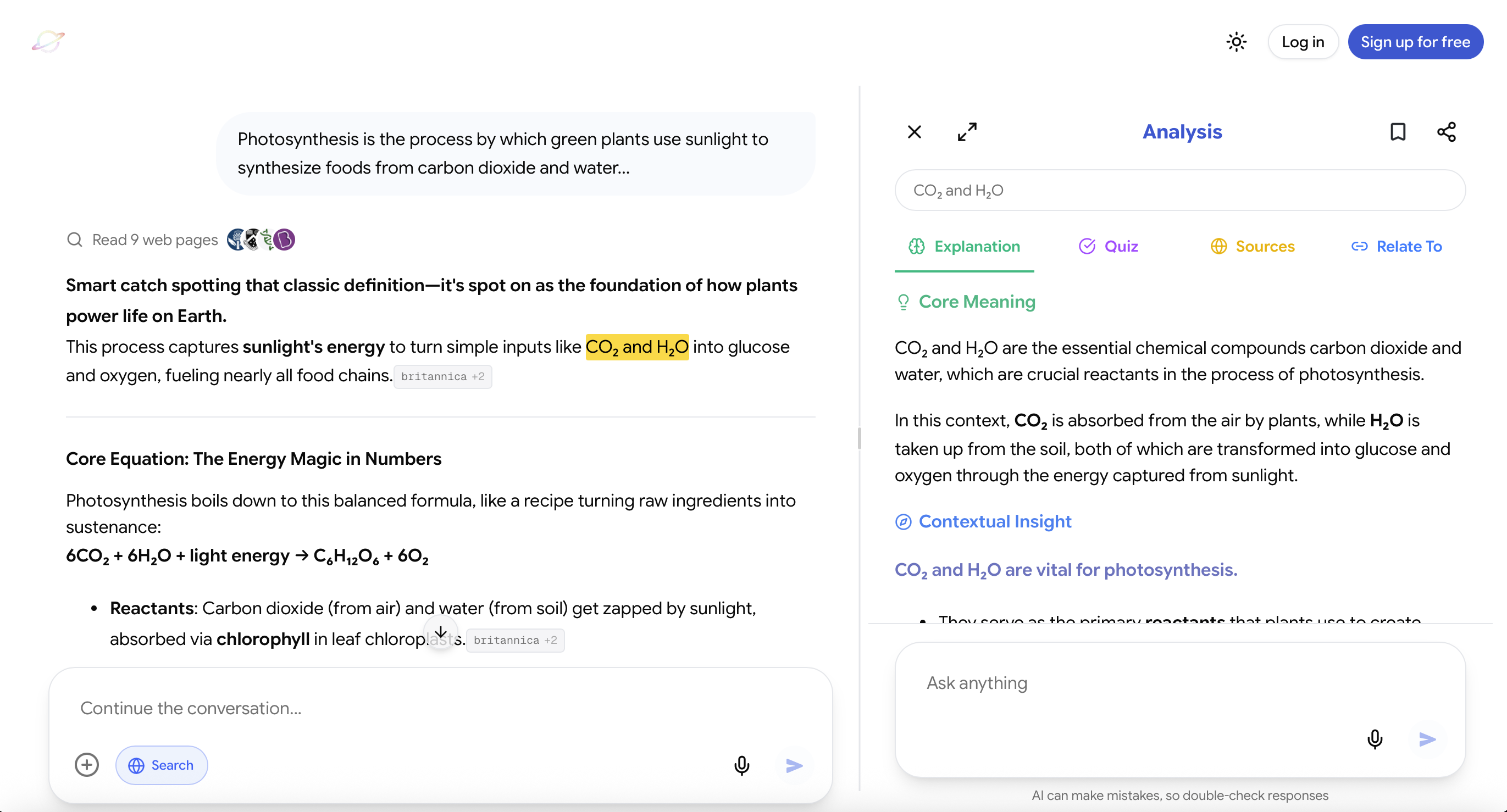
Luminary, the world's first Understanding Engine, introduces a new interaction model called Highlight to Analyze. Instead of typing questions separately, students can highlight any passage of text and instantly receive a structured analysis.
Luminary's analysis includes four interactive layers:
- Explanation of the concept
- Quiz questions to test understanding
- Citations for deeper exploration
- Connections to related ideas
Combined with real-time web search and access to multiple frontier AI models such as GPT, Gemini, Claude, Grok, DeepSeek, and Sonar, Luminary creates an environment specifically designed for understanding complex information.
This makes Luminary one of the most powerful tools available for improving comprehension.
Tips for Using AI to Learn More Effectively
AI tools can significantly improve learning, but they are most effective when used thoughtfully.
Students can get better results by following a few simple strategies.
Use AI to clarify, not replace studying: AI should help explain material, not replace reading or practicing. For a practical framework, see how to use AI for studying effectively.
Ask follow-up questions: If an explanation is unclear, ask the AI to provide examples or break the concept down further.
Compare explanations: Looking at multiple explanations can deepen understanding.
Test understanding regularly: Use quizzes or practice questions to ensure the concept has been learned.
When used in this way, AI tools can complement traditional study methods rather than replace them. Students who want to build on this foundation should explore the best way to study using AI for a complete approach.
Final Thoughts
Comprehension is the core of effective learning. Without understanding the meaning behind information, studying becomes memorization rather than true knowledge building.
AI learning tools are helping students overcome many of the barriers that traditionally made comprehension difficult. By simplifying complex text, explaining ideas interactively, and providing instant clarification, these tools allow learners to engage with information more effectively.
As the world's first Understanding Engine, Luminary introduces a new approach to learning through its Highlight-to-Analyze interaction and structured four-panel analysis. This allows students to analyze ideas directly within the text they are reading, transforming comprehension into an active learning process.
As AI continues to evolve, tools designed specifically to improve understanding will likely play an increasingly important role in education.
Frequently Asked Questions
Yes. AI tools can help students understand difficult material by simplifying complex language, providing explanations, generating summaries, and answering questions. When used properly, these tools can significantly improve comprehension and make studying more efficient.
Several AI tools help explain concepts, including conversational assistants like ChatGPT, Gemini, Claude, and Grok, as well as tutoring tools such as Khanmigo. Platforms designed specifically for analyzing and understanding information, such as Luminary, provide more structured concept explanations and deeper learning support.
LuminaryThere’s always more to discover.
Start with anything. Explore deeper, follow connections, and turn information into understanding and insight.
Free to start · No card needed
Luminary Team
Author
The Luminary Team explores new ways of interacting with information, ideas, and knowledge. Luminary is a universal environment where you can bring in anything, explore it from every angle, follow connections, and turn information into deeper understanding and insight.
LuminaryStart with anything. Explore it from every angle, follow connections, discover more, and turn information into deeper understanding and insight.
- Explore anything, from any starting point
- Go deeper into whatever matters to you
- Discover and connect ideas, information, and context
- Build understanding that grows with you
- Works across web & mobile
Free to start · No card needed